
If you’ve spent any time trying to rank a website this year, you already know something has shifted. Search isn’t just about ten blue links anymore it’s about showing up in ChatGPT answers, Perplexity summaries, and Google’s AI Overviews too. That’s exactly why AI SEO toolshave become the quiet backbone of almost every serious content strategy in 2026.
Whether you’re a solo blogger, a small business owner, or someone managing SEO for a dozen client sites, picking the right tool can save you dozens of hours a month and picking the wrong one can waste your budget on features you’ll never touch. In this guide, we’ll walk through the best AI SEO tools 2026, compare free and paid options, and help you figure out which one actually fits how you work.
What Are AI SEO Tools?
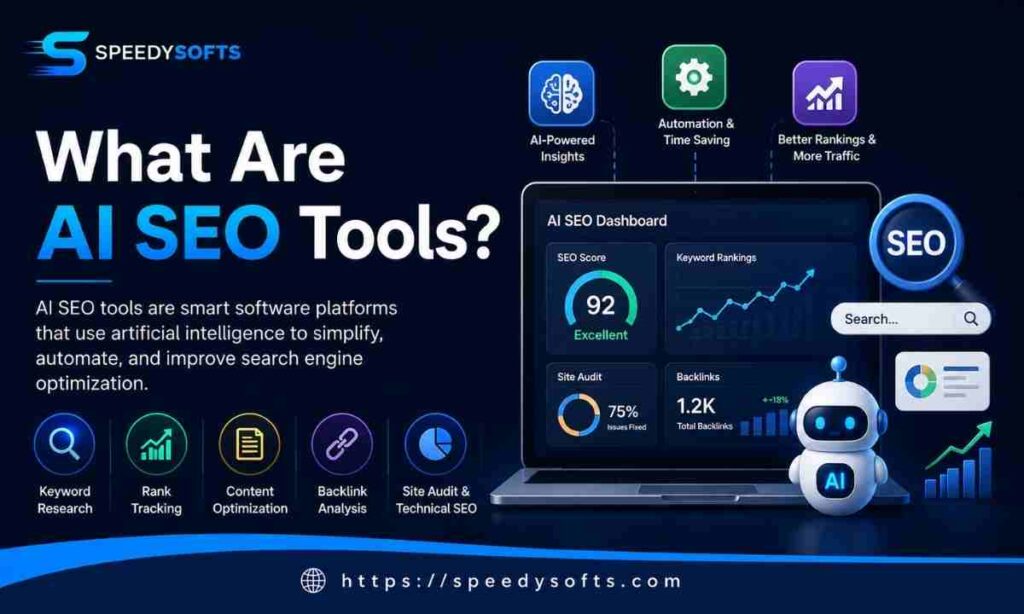
AI SEO tools are software platforms that use artificial intelligence and large language models to help you research keywords, optimize content, audit websites, and track how your brand performs not just on Google, but across AI search engines like ChatGPT, Gemini, and Perplexity.
Think of them as a smarter, faster version of the SEO checklist you used to do by hand. Instead of manually scanning ten competitor pages to figure out what headings to use, a tool like Surfer or Frase does that analysis in seconds and hands you a ready-made brief.
What makes 2026’s tools different from the ones you might remember from a few years back is the shift toward dual optimization. Older tools cared only about ranking on Google. Newer platforms also track whether your content gets cited inside an AI-generated answer a discipline often called Generative Engine Optimization (GEO) or Answer Engine Optimization (AEO).
In short, a modern AI SEO tool typically helps with:
- Keyword and topic research, including long-tail and question-based queries
- Content briefs and on-page optimization scoring
- Technical SEO audits (site speed, crawlability, broken links)
- Backlink analysis and competitor tracking
- AI visibility monitoring across ChatGPT, Gemini, and Perplexity
It’s worth noting that traditional SEO fundamentals haven’t disappeared they’ve just gained a new layer on top. ChatGPT and Perplexity often rely on Google’s search index as one of their underlying data sources, so a page that’s technically sound and well-structured for Google still tends to have a better shot at getting cited inside an AI answer. That’s why the smartest tools in 2026 don’t treat “SEO” and “AI visibility” as separate categories they fold both into a single workflow.
Another shift worth mentioning: these tools increasingly show you not just whether you rank, but which sources an AI model pulled from to build its answer. Knowing that a chatbot is citing a specific forum thread or review site for your target topic gives you a concrete, actionable target get mentioned there, or create content that answers the same question more directly than what’s currently being cited.
Benefits of AI SEO Tools
So why bother adding another subscription to your stack? Because the time savings and accuracy gains are hard to ignore once you’ve tried them.
1. They save serious hours. A manual SEO audit can easily eat up a full workday. AI tools compress that into minutes, flagging issues like thin content, missing meta tags, or slow-loading pages almost instantly.
2. They reduce guesswork. Instead of guessing what a “good” article looks like, these platforms show you exactly what’s working for the pages already ranking on page one.
3. They help you show up in AI answers. As more people ask ChatGPT or Gemini questions instead of typing them into Google, visibility tracking across these platforms has become essential — not optional.
4. They scale content production. For teams publishing dozens of articles a month, AI-assisted briefs and drafts keep quality consistent without burning out writers.
5. They surface data you’d otherwise miss. Backlink gaps, topical clusters, and competitor keyword overlaps are the kind of insights that used to require a full-time analyst.
6. They make reporting easier. Instead of stitching together numbers from five different spreadsheets, most platforms now generate client-ready or team-ready reports automatically, which is a genuine time-saver for agencies juggling multiple accounts.
7. They help smaller teams compete with bigger budgets. A one-person blog or a five-person startup can now run audits, track competitors, and monitor AI citations at a level that used to require a dedicated analyst — leveling the playing field considerably.
None of this means AI replaces human judgment. The best results still come from pairing these tools with a writer or strategist who understands the audience and can add real experience to the content which, as we’ll cover later, matters a lot for Google’s trust signals. A tool can tell you what a top-ranking page includes structurally, but it can’t replace the lived experience, original photos, or firsthand testing that makes content genuinely trustworthy to both readers and search engines.
Best AI SEO Tools 2026
Below is a breakdown of the platforms that consistently show up in expert reviews and real-world SEO workflows this year. Each one solves a slightly different problem, so pay attention to what each tool is actually best at.
ChatGPT
ChatGPT isn’t a dedicated SEO platform, but it’s become a genuine daily driver for SEO research and content planning. Many practitioners use it to brainstorm topic clusters, draft outlines, summarize long competitor articles, or quickly rewrite clunky sentences.
Where it falls short is structured SEO data it can’t pull real keyword volumes or track your rankings. Pair it with a dedicated research tool for the numbers, and use ChatGPT for the thinking and drafting side of the process.
Best for: Idea generation, outlines, and quick content drafts.
Surfer SEO
Surfer remains one of the most trusted names in content optimization heading into 2026. Its Content Editor analyzes the top-ranking pages for your target keyword and gives you a live score as you write, based on structure, word count, and semantic relevance rather than just keyword density.
Recent updates have added a built-in Humanizer, a plagiarism checker, and faster AI drafting, along with rank-drop detection so you know quickly if an article needs a refresh.
Best for: Writers and teams who want real-time, on-page content scoring.
Semrush AI Toolkit
Semrush has long been the “Swiss Army knife” of SEO, and its AI layer in 2026 genuinely earns that reputation. The standout feature is AI visibility tracking, which monitors how often your brand gets mentioned across ChatGPT, Gemini, Perplexity, and Google’s AI Mode — reportedly across a huge volume of prompts and multiple regions.
Combined with its AI Writing Assistant and automated site audits, Semrush works well as a strategic command center, even if you still need to execute the recommendations yourself.
Best for: Agencies and in-house teams that need one platform for research, audits, and AI visibility tracking.
Ahrefs AI Features
Ahrefs built its name on having the largest, most frequently refreshed backlink index in the industry and that’s still true. Its newer AI layer, sometimes called Ahrefs AI, adds keyword research assistance, content helper scoring, and brand tracking through its Brand Radar feature.
If backlinks and competitive research are central to your strategy, Ahrefs is hard to beat, even with the added AI features feeling more like an enhancement than a full rebuild.
Best for: Backlink research and competitive content planning.
Frase
Frase blends keyword research, content briefs, and a writing editor into a single workflow. Give it a target keyword, and it analyzes the top-ranking pages, pulls out common questions and subtopics, and generates a structured outline you can build from.
Its dual SEO and GEO scoring shows how well your draft aligns with both traditional Google ranking factors and AI-platform visibility, which makes it a favorite for teams producing high volumes of content.
Best for: Fast research-to-brief workflows for content teams.
Clearscope
Clearscope is built specifically for optimizing human-written content. It scores your draft against top-ranking competitors in real time, focusing on topical relevance rather than stuffing in keywords.
It’s pricier than some alternatives, but its clean interface and accuracy make it a favorite among professional content teams who want a tool that stays out of the way while writing.
Best for: Polishing already-written content for topical completeness.
Jasper
Jasper leans more toward content generation and summarization than deep SEO analytics. It offers a range of templates for drafting outlines, rewriting sections, and condensing long articles into quick summaries — useful when you’re managing a large content library and need fast recaps.
Best for: Content teams that want drafting templates alongside light SEO guidance.
MarketMuse
MarketMuse takes a different angle: instead of optimizing one article at a time, it inventories your entire site to model topical authority. It then outputs prioritized topic clusters, briefs, and strategy documents based on where your content has gaps.
This makes it especially useful for larger sites trying to build genuine subject-matter authority rather than just chasing individual keywords.
Best for: Long-term content strategy and topical authority planning.
NeuronWriter
NeuronWriter combines competitor analysis, content creation guidance, and internal linking suggestions in one dashboard. Its standout feature is how it studies competitor pages ranking for your target term and translates that into concrete recommendations for your own draft.
Best for: Competitor-driven content optimization on a budget.
Scalenut
Scalenut positions itself as an all-in-one content marketing platform, combining keyword clustering, AI-assisted drafting, and content briefs. It’s popular with smaller teams that want an end-to-end workflow research, draft, optimize without juggling separate tools.
Its content planner also groups related keywords into clusters automatically, which saves the manual work of organizing a spreadsheet of terms into a coherent content calendar.
Best for: Small teams wanting a single platform from research to publishing.
SE Ranking AI
SE Ranking punches above its price point. It bundles rank tracking, site audits, keyword research, backlink monitoring, and AI-powered content optimization into one affordable suite.
It’s not as deep as Semrush in any single category, but for solo operators and small agencies, the price-to-value ratio is excellent. The dashboard is also noticeably less cluttered than some enterprise competitors, which makes it easier to find the specific report you actually need without digging through menus.
Best for: Budget-conscious users who still want a full SEO toolkit.
Best Free AI SEO Tools in 2026
Not every site needs an enterprise budget. If you’re just getting started, several tools offer genuinely useful free tiers or trials.
| Tool | Free Offering | Best For |
| ChatGPT | Free tier available | Brainstorming, outlines, quick edits |
| Google Search Console | Completely free | Tracking real indexing and click data |
| Ubersuggest | Limited free searches daily | Basic keyword ideas for small sites |
| Frase | Free trial (short-term) | Testing content briefs before committing |
| NeuronWriter | 7-day free trial | Competitor content analysis |
A smart approach for beginners is combining Google Search Console (which is always free) with one AI content tool’s trial period to test whether the paid version is worth it before committing.
Best AI SEO Tools for Beginners
If you’re new to SEO, the sheer number of features in tools like Semrush or Ahrefs can feel overwhelming. Beginners tend to do better starting with something simpler and more guided.
- Ubersuggest a clean, affordable interface with straightforward keyword and site-health data, good for a first personal blog or small site.
- Frase walks you through research, outline, and optimization in one guided flow, which helps if you don’t yet know what “good” SEO content looks like.
- SE Ranking offers a full toolkit at a lower price point, so beginners aren’t paying for enterprise features they won’t use for months.
The goal at this stage isn’t finding the most powerful tool it’s finding one that teaches you the fundamentals without burying you in dashboards you don’t understand yet.
Best AI SEO Tools for Small Businesses
Small business owners usually need something that balances affordability with genuinely actionable insights, since there often isn’t a dedicated marketing team to interpret complex reports.
- Ubersuggest — its lifetime-access pricing option makes it attractive for a single-site small business that wants to avoid recurring subscription costs.
- SE Ranking — combines rank tracking, audits, and content optimization at a price that doesn’t require enterprise-level budget.
- Semrush (entry plans) — worth it once a small business starts investing seriously in content and wants AI visibility tracking across ChatGPT and Gemini as well as Google.
A good rule of thumb: if you’re publishing fewer than four articles a month, a lighter tool like Ubersuggest or SE Ranking will likely cover your needs without unnecessary cost.
AI SEO Optimization: Best Practices
Owning a great tool doesn’t automatically mean better rankings. A few practices consistently separate the sites that actually grow from the ones that stall out and interestingly, most of them cost nothing beyond time and consistency.
- Write for the reader first, optimize second. Content that reads naturally and answers the question directly tends to perform better in both Google rankings and AI Overviews than text stuffed with keyword variations.
- Structure content for skimmability. Short paragraphs, clear headings, and bullet points make it easier for both readers and AI crawlers to extract the key information.
- Answer the question early. Put a direct, concise answer near the top of each section this is exactly the format AI Overviews and featured snippets tend to pull from.
- Keep your technical foundation solid. No amount of AI-generated content will rank well on a slow, poorly indexed site. Fast load times and clean site architecture still matter enormously.
- Build topical depth, not just keyword coverage. Covering a subject thoroughly across multiple linked articles builds the kind of topical authority both Google and AI models reward.
- Track AI visibility, not just rankings. Since more searches now start (or end) inside a chatbot, monitoring citations across ChatGPT and Perplexity is becoming as important as tracking your position on Google.
- Update older content regularly. Rankings and AI citations shift often, so revisiting your best-performing pages every few months to refresh stats, examples, and outdated claims tends to pay off more than constantly publishing new articles.
- Add genuine first-hand insight. A quick personal note, a real example, or a lesson learned from actually using a product or process signals the kind of experience that both readers and search algorithms have come to value more highly.
None of these practices require expensive software on their own they’re habits. The tools simply make it faster to spot where you’re falling short of them.
Surfer SEO Review
Surfer deserves a closer look since it’s consistently named among the top content optimization tools of 2026. Its Content Editor pulls data from the top-ranking pages for your target keyword and translates it into a practical scoring system covering structure, length, and semantic terms to include.
What stands out:
- Real-time content scoring as you write, rather than a one-time audit
- A built-in Humanizer tool to smooth out AI-generated drafts
- Auto-Optimize suggestions for existing published content
- Rank-drop detection that flags when an article needs a refresh
Where it falls short:
- Pricing sits above some competitors like SE Ranking or NeuronWriter
- It’s a content tool, not a full strategy platform you’ll still need separate backlink or technical audit tools
Verdict: Surfer is one of the strongest choices if your main goal is making individual articles rank well, especially for teams publishing content regularly. It’s not a replacement for a broader SEO strategy, but as a writing companion, it’s hard to beat.
AI SEO Tools Comparison
With so many tools covering overlapping ground, a quick side-by-side view makes the differences much easier to spot than scrolling through separate reviews. Here’s a snapshot built from what each platform is genuinely best known for in 2026.
| Tool | Best For | Starting Price | AI Search Tracking |
| Surfer SEO | Content optimization | Mid-range | Yes |
| Semrush AI Toolkit | All-in-one strategy | Higher-end | Yes (wide coverage) |
| Ahrefs AI | Backlink & competitor research | Mid to higher-end | Yes |
| Frase | Research-to-brief workflow | Affordable | Yes (beta GEO scoring) |
| Clearscope | Human content refinement | Higher-end | Limited |
| SE Ranking AI | Budget full-suite | Affordable | Yes |
| Ubersuggest | Beginners, small sites | Very affordable / lifetime option | Yes |
| NeuronWriter | Competitor-based optimization | Affordable | Limited |
Prices shift often, so always check each provider’s current pricing page before subscribing.
How to Choose the Right AI SEO Tool
With so many overlapping options, it helps to narrow your decision down to a few practical questions rather than trying to compare every feature side by side.
- What’s your biggest bottleneck right now? If it’s writing speed, prioritize a content editor like Surfer or Frase. If it’s backlinks, Ahrefs is the stronger pick.
- Do you need AI visibility tracking? If your audience increasingly searches through ChatGPT or Gemini, don’t skip this feature it’s quickly becoming standard rather than optional.
- What’s your realistic monthly budget? Enterprise tools like Semrush make sense once you’re managing multiple sites or clients, but a solo blogger rarely needs that scale.
- How technical is your team? Some platforms assume SEO familiarity; others, like SE Ranking or Ubersuggest, are built with simpler dashboards for less experienced users.
- Does it integrate with your existing workflow? A tool that doesn’t fit into how you already publish WordPress, Google Docs, or a CMS adds friction instead of removing it.
There’s rarely a single “best” answer here. The right tool is the one that matches your budget, skill level, and content volume not necessarily the one with the most features.
A practical approach many experienced marketers use: start with a free trial of one content optimization tool and one all-in-one suite, run both against a piece of content you’re already planning to publish, and compare which recommendations actually feel useful versus which ones feel like noise. That two-week test tells you more than any comparison article including this one ever could.
AI SEO Tools Reddit Discussions
If you browse SEO communities on Reddit, a few recurring themes come up again and again when people discuss AI SEO tools in 2026.
- Many users caution against tools that slap “AI-powered” on basic automation without offering real insight a complaint echoed across several independent reviews this year.
- Surfer and Frase are frequently recommended for solo creators and small teams who need practical content guidance without an enterprise price tag.
- There’s a growing thread of discussion around AI visibility tracking, with users comparing notes on which tools most accurately reflect how often their brand actually shows up in ChatGPT or Perplexity answers.
- A common piece of advice: cross-check any tool’s keyword or traffic data against Google Search Console before trusting it fully, since some AI estimates can drift from real-world numbers.
The overall consensus mirrors expert reviews no single tool does everything perfectly, so most experienced users end up combining two or three platforms rather than relying on one.
Another recurring point worth flagging: several threads warn against judging a tool purely by its optimization score. A handful of users report chasing a perfect content score only to see the page underperform, since a high score doesn’t automatically mean the writing is genuinely useful or well-organized for readers. The takeaway from these discussions is refreshingly consistent treat every tool’s suggestions as a starting point, not a final grade.
Pros and Cons of AI SEO Tools
Before committing budget to any platform, it helps to weigh the honest trade-offs rather than just the marketing pitch. Here’s a balanced look at what these tools genuinely deliver and where they still fall short.
Pros:
- Massively cuts down research and audit time
- Removes a lot of guesswork from content structure and topic coverage
- Helps track visibility across both Google and AI search engines
- Scales content production without sacrificing consistency
- Surfaces data (backlink gaps, topic clusters) that’s hard to find manually
Cons:
- Subscription costs can add up quickly if you use several tools at once
- AI-generated data isn’t always accurate — it still needs human verification
- Over-reliance on optimization scores can lead to robotic-sounding writing
- Some “AI” tools are just basic automation with a new label
- None of these tools replace genuine subject-matter expertise or original research
Weighing these honestly before you subscribe will save you from the common trap of collecting tools you rarely open past the first month.
Frequently Asked Questions
What is the best AI SEO tool?
There isn’t one single winner Surfer SEO is excellent for content optimization, while Semrush leads for all-in-one strategy and AI visibility tracking.
Which AI SEO tool is free?
Google Search Console is completely free, and tools like Ubersuggest and Frase offer limited free access or trials to get started.
Is Surfer SEO worth it?
Yes, if your main goal is optimizing individual articles its real-time scoring and Humanizer features are genuinely useful for content teams.
Which AI SEO tool is best for beginners?
Ubersuggest and Frase are the most beginner-friendly, offering simpler dashboards and guided workflows without overwhelming detail.
What are the best AI SEO tools for small businesses?
Ubersuggest, SE Ranking, and entry-level Semrush plans all balance affordability with genuinely actionable features for smaller sites.
Can AI improve SEO?
Yes AI speeds up research, content optimization, and technical audits, though it still works best alongside human judgment and original expertise.
Do AI SEO tools help with ChatGPT and AI Overviews visibility?
Increasingly, yes platforms like Semrush, Ahrefs, and Frase now track how often your brand appears in ChatGPT, Gemini, and Perplexity answers.
Final Verdict
Choosing the right AI SEO tool in 2026 really comes down to knowing what you actually need help with. If writing better content faster is your priority, Surfer or Frase will likely earn their keep quickly. If you’re managing a bigger operation and need backlinks, audits, and AI visibility tracking under one roof, Semrush or Ahrefs make more sense.
At the end of the day, no tool replaces genuinely useful, well-researched content written with your reader in mind. Use these platforms to save time and sharpen your strategy, not as a shortcut around doing the work. Pair the right tool with real expertise, and you’ll be well positioned for both Google’s search results and the growing world of AI-powered search.
If you take away one thing from this guide, let it be this: start small, test before you commit, and let your actual workflow not a feature list decide which AI SEO tool earns a permanent spot in your toolkit.
Looking for more tools to round out your content workflow? Check out our roundup of the best AI photo editing tools in 2026 for visuals to pair with your next optimized article. For official guidance straight from Google on how search ranking works, see Google’s Search Central documentation.

If you are tired of broken links and slow redirects, just use this one. It is the most direct way to access gamezonephlogin without any hassle.
Registering was so easy, I was in the game within minutes. The welcome bonuses are a great touch for new players. Get started at 567jiliregister
Yo, 8kbetlink on my radar! Quick links to the action, and the site’s mobile friendly which is a huge plus. If you’re always on the go like me, this is key. Give it a shot! 8kbetlink
If you love slots then this is the place to be. The variety is insane and the loading times are very short. Big shoutout to 50jilislot for the awesome vibes.
I’ve been looking for a reliable spot and this one really delivers. The interface is smooth and everything loads quickly. Definitely worth a try! phjljl22
I was skeptical at first but this platform is legit. The customer service is very helpful and the withdrawal process is quick. Give krmmwin a try if you want a reliable site.
Finally a platform that understands what Asian players need. The login is secure and the customer support is actually helpful. Great job plus777asialogin.
Easy to navigate and the mobile version works perfectly. I can play anywhere without any lag. Love jili49login