
Picking your first (or next) programming language can feel like a bigger decision than it actually is. The truth? There’s no single “best” language for everyone there’s only the best language for your specific goal, whether that’s landing a job, building AI tools, or shipping your first app.
In this guide, we’ll break down the best programming language to learn in 2026 based on real job demand, salary data, and where the industry is actually heading not just hype. Whether you’re a complete beginner or a developer planning your next skill investment, you’ll find a clear answer here.
The tech landscape has shifted noticeably over the past couple of years. AI adoption has pulled enormous demand toward Python and data-adjacent skills, while cloud-native infrastructure has quietly made Go one of the best-paid specializations around. At the same time, the fundamentals haven’t changed much JavaScript still runs the web, Java still runs the enterprise world, and beginners still learn fastest with simple, readable syntax. Understanding both the constants and the shifts will help you make a decision you won’t regret in a year or two.
What Is the Best Programming Language to Learn?
If you want one honest answer: Python is the best overall programming language to learn in 2026 for most people. It tops job posting volume, dominates AI and data work, and remains one of the easiest languages for beginners to pick up.
That said, “best” depends heavily on context. A student aiming for a Google internship, a career-switcher wanting a fast job, and a hobbyist building a mobile game all need different tools. Here’s a quick way to think about it:
- Want the broadest job security? Python or Java.
- Want to build for the web? JavaScript and TypeScript.
- Want to work in AI or data science? Python, with SQL as a close companion.
- Want top-tier pay and don’t mind a steeper climb? Rust or Go.
- Want to build mobile apps? Kotlin (Android) or Swift (iOS).
Keep that framework in mind as we go every section below builds on it.
Best Programming Language to Learn as a Beginner
Beginners do best with a language that gives fast feedback, has simple syntax, and comes with a huge library of tutorials when you get stuck.
Python is the clear winner here. Its syntax reads almost like plain English, and you can build something functional a calculator, a simple game, a data script within your first week of learning. It also gives you a head start if you eventually want to move into AI or automation.
JavaScript is a close second, especially if you’re more excited about building things you can see in a browser right away. Watching a webpage respond to your code in real time is a powerful motivator for new learners.
A few other solid beginner-friendly picks:
- Kotlin — great if your end goal is Android app development from day one.
- Scratch or block-based tools — not a real language, but useful if you’re teaching a child or absolute first-timer the logic of programming before moving to text-based code.
Quick tip: Don’t try to learn a language “completely” before building something. Pick a small project a to-do list app, a budget tracker, a quiz game and learn just enough syntax to finish it. You’ll retain far more this way than through passive tutorial-watching.
It’s also worth setting realistic expectations early. Most beginners can write simple, working programs within a few weeks, but genuine job-readiness usually takes several months of consistent practice, not just a single course. Treat the first month as building comfort with the basics variables, loops, functions and the following months as building real, shareable projects. Employers and even freelance clients care far more about what you’ve built than which certificate you hold.
Best Programming Language to Learn for Jobs
If your priority is simply getting hired as fast as possible, job posting data tells a fairly consistent story in 2026.
Python and JavaScript/TypeScript sit at the top of nearly every hiring report, appearing across data science, backend development, DevOps, and full-stack web roles. Java remains deeply embedded in enterprise environments banks, insurance companies, and large-scale internal platforms still run on it heavily, which keeps hiring volume strong even if it’s not the trendiest choice.
Here’s a simplified breakdown by job goal:
| Career Goal | Recommended Language |
| Fastest general hiring volume | Python or JavaScript |
| Enterprise / corporate software jobs | Java or C# |
| Cloud & DevOps roles | Go |
| High-paying specialized roles | Rust |
| Data analytics / reporting roles | SQL (paired with Python) |
One detail worth remembering: SQL isn’t a traditional programming language, but it shows up in an enormous share of job postings because virtually every application needs someone who can query and manage data. Pairing SQL with Python or Java significantly boosts your hireability.
It’s also worth noting that job postings don’t always reflect starting difficulty. Python shows up in more postings than almost anything else, but that also means more competition from other applicants. Less crowded skills like Go or Rust may have fewer total openings, but a smaller applicant pool per role which is part of why experienced developers in those languages often negotiate stronger offers.
Best Programming Language to Learn for the Future
Thinking five or ten years ahead changes the calculus slightly. A few languages stand out for long-term relevance rather than just current demand.
Rust continues to gain ground as a language built for memory safety and performance, and it’s increasingly chosen for infrastructure, browsers, and performance-critical systems where older languages like C++ used to dominate by default. Its learning curve is steep, but the long-term payoff both in salary and in job security looks strong.
Go keeps growing alongside the cloud-native world. As more companies build microservices and containerized infrastructure, Go’s simplicity and speed make it a durable long-term bet, especially if you enjoy backend and systems-level work.
TypeScript has effectively become the default way serious teams write JavaScript today, and that trend shows no sign of reversing. Learning it now future-proofs your web development skills rather than leaving you dependent on plain JavaScript alone.
Python, despite already being dominant, still shows no clear successor on the horizon its ecosystem for AI and data work is simply too large to displace quickly.
Worth watching, though not yet essential to learn: newer AI-assisted development workflows are changing how code gets written day-to-day, but they haven’t changed which underlying languages matter. If anything, understanding a solid, widely-used language well enough to review and debug AI-generated code has become more valuable, not less, since someone still needs to catch the mistakes a generated snippet might introduce.
Best Programming Language to Learn for AI
If artificial intelligence and machine learning are your target field, the decision is refreshingly simple: learn Python.
Python’s ecosystem for AI is unmatched libraries like PyTorch, TensorFlow, and scikit-learn are built around it, and nearly every AI research paper or production system published today ships with Python code. A large majority of machine learning engineers use it as their primary language.
Beyond Python itself, a well-rounded AI skill set in 2026 usually includes:
- SQL for pulling and shaping the data your models train on
- Basic statistics and linear algebra not a language, but essential for understanding what your models are actually doing
- Familiarity with cloud platforms (AWS, GCP, or Azure) since most AI workloads run on rented infrastructure, not local machines
You don’t need to learn a second programming language to break into AI. Depth in Python, paired with strong data fundamentals, will take you further than spreading yourself across multiple languages too early.
It’s also worth separating two very different AI-related career paths, since they call for different depth of skill. If you want to use AI tools to build products chatbots, automation scripts, simple apps powered by an API a working knowledge of Python and how to call a model’s API is often enough. If you want to build or research the models themselves, you’ll need to go much deeper into Python’s data science stack, along with a solid grounding in math and statistics that no single language teaches you on its own.
Best Programming Language to Learn for Software Engineering
If your goal is a broad, stable software engineering career not tied to one specific niche a slightly different mix makes sense.
Java remains a cornerstone of traditional software engineering roles, particularly in large organizations that need long-term, maintainable systems. Its strict typing and mature tooling make it a common choice for teaching solid engineering fundamentals.
C# plays a similar role, especially if you’re interested in enterprise software, Windows applications, or game development through Unity. It has a smoother learning curve than Java for many newcomers while offering comparable job stability.
Go and Rust round out this category for engineers interested in backend systems, infrastructure, or performance-sensitive applications, where reliability and speed matter more than rapid prototyping.
A strong software engineer in 2026 typically doesn’t stop at one language they build depth in one (often Java, C#, or Python) and pick up a second (often Go or TypeScript) as their career grows.
Beyond language choice, employers hiring for software engineering roles increasingly look for comfort with the surrounding ecosystem too: version control (Git), basic cloud deployment, and writing tests. A candidate who knows Java reasonably well but also understands how to ship and monitor code in production will often beat one who knows three languages but has never deployed anything beyond a local machine.
Best Programming Language to Learn for Game Development
Game development has its own distinct language landscape, shaped heavily by which engine you plan to use.
- C# is the primary language for Unity, one of the most widely used game engines for indie and mid-size studios alike. If you’re just starting in game dev, this is usually the fastest path to actually shipping a playable game.
- C++ powers Unreal Engine and remains the backbone of most AAA game studios, where performance and low-level control over hardware are critical.
- Python shows up in game development too, though usually for tooling, scripting, and automation rather than the core game engine itself.
If you’re unsure which to start with, C# via Unity is generally the gentler entry point, while C++ and Unreal suit those aiming for larger studio roles or performance-heavy projects down the line.
Beyond the big two engines, it’s worth knowing that indie developers increasingly experiment with alternative tools Godot’s GDScript, for instance, has grown a loyal following for smaller, lighter projects. But if your goal is employability within an existing studio pipeline, sticking with C# or C++ remains the far safer bet.
Top 10 Best Programming Languages to Learn in 2026
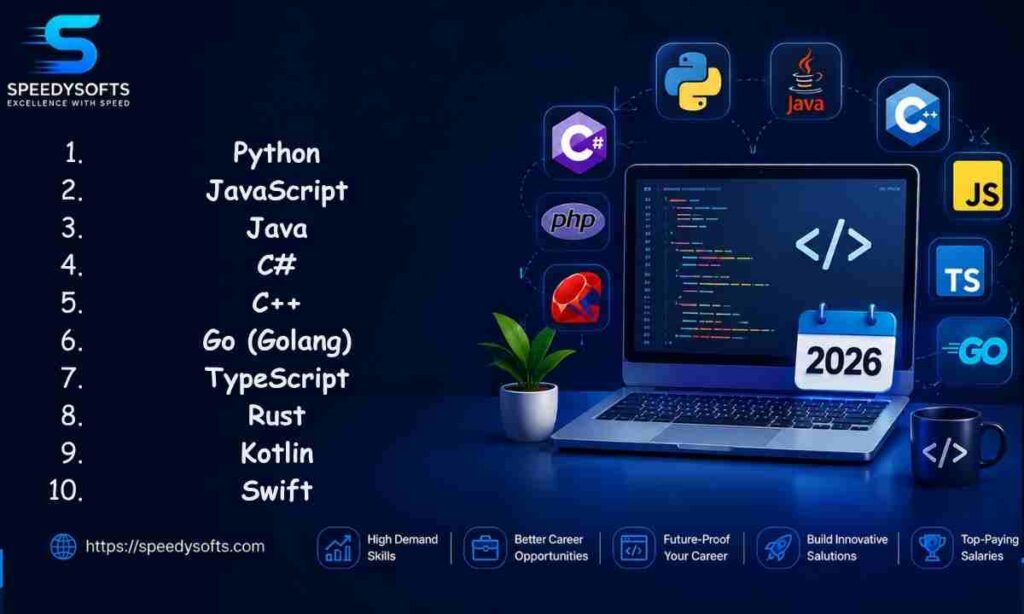
Here’s a closer look at the ten languages that matter most this year, based on job demand, salary signals, and where each one genuinely shines.
Python
Python continues to sit at the top of nearly every “most in-demand” ranking in 2026, and its lead over the second-place language has only widened as AI adoption accelerates across industries.
Best for: AI, machine learning, data science, backend development, automation, and scripting.
Why it’s popular: Simple, readable syntax combined with an enormous ecosystem of libraries makes it the default choice for beginners and experts alike.
Salary signal: Python developers in the U.S. typically earn in the low-to-mid six figures, with machine learning specialists earning meaningfully more as they gain experience.
Beyond the numbers, Python’s biggest advantage might simply be how many different doors it opens. The same core language skills carry you from a first automation script, to a data analysis project, to a production machine learning pipeline without needing to switch tools along the way.
JavaScript
JavaScript remains the only language that runs natively in every web browser, which alone guarantees it a permanent place near the top of any in-demand list.
Best for: Front-end development, interactive web apps, and full-stack work through Node.js.
Why it’s popular: Every company with a website needs developers who understand it there’s simply no substitute for browser-native code.
Salary signal: Solid mid-range salaries, with senior full-stack developers who know modern frameworks like React earning noticeably more.
Beyond raw salary, JavaScript’s biggest strength is flexibility the same language skills carry you from a small landing page to a full backend service through Node.js, without ever needing to learn a second language just to go full-stack.
TypeScript
TypeScript has become the preferred way serious teams write JavaScript in production environments, thanks to the safety net of static typing.
Best for: Large-scale web applications, enterprise front-end and full-stack projects.
Why it’s popular: It catches type-related bugs before they reach production, which matters enormously as codebases grow.
Salary signal: Comparable to or slightly above standard JavaScript roles, given its association with more senior, structured engineering positions.
Java
Java’s reputation as the backbone of enterprise software hasn’t faded. Large banks, insurers, and government systems still depend heavily on it.
Best for: Enterprise applications, Android development (alongside Kotlin), and large-scale backend systems.
Why it’s popular: Mature tooling, strong backward compatibility, and a massive existing codebase across major industries keep demand steady.
Salary signal: Reliable, strong salaries, particularly in finance and large corporate environments.
Java’s steady reputation isn’t glamorous, but it’s genuinely valuable companies running mission-critical systems tend to prioritize stability over trendiness, which keeps demand for solid Java developers consistent even during broader hiring slowdowns.
C#
C# is Microsoft’s flagship language, closely tied to the .NET ecosystem and the Unity game engine.
Best for: Windows applications, enterprise backend systems, and game development.
Why it’s popular: It offers many of Java’s enterprise strengths with a friendlier learning curve for many newcomers.
Salary signal: Competitive with Java, with an added edge in regions where .NET is the corporate standard.
C# also benefits from Microsoft’s continued investment in the .NET ecosystem, which keeps tooling, documentation, and enterprise support strong a meaningful factor for long-term career stability.
Go (Golang)
Go was built at Google specifically to solve the pain points of large-scale, concurrent systems and in 2026, it’s the dominant choice for cloud infrastructure.
Best for: Microservices, cloud-native applications, DevOps tooling, and container orchestration.
Why it’s popular: It compiles to a single binary, starts almost instantly, and handles concurrency far more simply than older alternatives.
Salary signal: Go developers often command a noticeable premium over Python or Java peers, driven by strong demand and a smaller talent pool.
Companies building large-scale infrastructure think container orchestration platforms or high-traffic APIs increasingly standardize on Go specifically because its simplicity makes large codebases easier to maintain across bigger engineering teams.
Rust
Rust has built a reputation as the language for developers who need both performance and safety, without the classic pitfalls of manual memory management.
Best for: Systems programming, performance-critical infrastructure, and security-sensitive applications.
Why it’s popular: Its compiler catches entire categories of bugs like memory leaks and data races before code ever runs.
Salary signal: Among the highest-paid languages on this list, largely because experienced Rust developers remain relatively scarce.
If performance and tooling interest you generally, it’s also worth exploring how AI-assisted development tools are changing workflows across languages like Rust our breakdown of the best AI photo editing tools in 2026 touches on a similar theme of how AI is reshaping creative and technical tooling alike, even outside of pure coding work.
C++
C++ remains the language of choice wherever raw performance and hardware-level control matter most.
Best for: AAA game development, high-frequency trading systems, embedded systems, and performance-critical applications.
Why it’s popular: Decades of tooling, libraries, and industry trust make it hard to displace in performance-sensitive fields.
Salary signal: Strong, particularly in specialized fields like game engines and financial systems.
Kotlin
Kotlin is Google’s preferred language for modern Android development, offering a cleaner, safer alternative to older Java-based Android code.
Best for: Android app development, and increasingly, backend services through frameworks like Ktor.
Why it’s popular: It interoperates smoothly with existing Java code while removing much of Java’s boilerplate.
Salary signal: Solid mobile development salaries, especially for developers comfortable across both Kotlin and Java.
Swift
Swift is Apple’s language for building iOS, macOS, and watchOS applications, designed to be safer and faster than its predecessor, Objective-C.
Best for: iOS and macOS app development.
Why it’s popular: It’s the only realistic path into native Apple app development, and Apple’s ecosystem remains a huge, stable market.
Salary signal: Competitive mobile development pay, particularly for developers who can ship polished, App Store-ready apps.
Programming Language Comparison (Salary, Demand, Difficulty & Learning Time)
| Language | Job Demand | Difficulty | Typical Learning Time | Salary Range (US, approx.) |
| Python | Very High | Easy | 2–3 months to basics | $95K–$160K+ |
| JavaScript | Very High | Moderate | 3–4 months to basics | $95K–$150K |
| TypeScript | High | Moderate | 1–2 months (after JS) | $100K–$155K |
| Java | High | Moderate | 3–4 months to basics | $100K–$150K |
| C# | High | Moderate | 3–4 months to basics | $95K–$145K |
| Go | Growing fast | Moderate | 2–3 months to basics | $110K–$160K |
| Rust | Growing, premium pay | Hard | 4–6 months to basics | $130K–$200K+ |
| C++ | Steady, specialized | Hard | 4–6 months to basics | $105K–$160K |
| Kotlin | Steady (mobile) | Moderate | 2–3 months (after Java basics) | $95K–$140K |
| Swift | Steady (mobile) | Moderate | 2–3 months to basics | $95K–$140K |
These figures are general benchmarks and vary widely by location, company size, and experience level treat them as directional, not exact.
Best Programming Language to Learn Reddit Users Recommend
Programming communities on Reddit tend to converge on a few consistent recommendations when this question comes up, regardless of which subreddit you’re browsing.
- Python is the near-universal answer for beginners, especially for anyone unsure yet what field they want to move into it keeps the most doors open.
- JavaScript gets recommended constantly for anyone excited about seeing visible results fast, since building a webpage feels more tangible early on than command-line output.
- Experienced developers frequently push back against language-hopping, pointing out that going deep in one language and shipping real projects beats shallow exposure to five languages.
- Rust and Go come up often in threads about “future-proofing” your career, with users noting the pay premium but also warning that they’re a poor choice as a first language.
- A recurring piece of advice: don’t ask “what’s the best language” in isolation ask “what do I want to build,” and let that answer the language question for you.
The overall sentiment mirrors what the data shows: there’s no universally “correct” choice, but Python remains the safest starting point for the largest number of people.
A less obvious pattern that shows up in these discussions: many developers who switched careers into tech say the language mattered far less than the discipline of showing up daily. Threads full of self-taught developers who landed jobs tend to credit consistent, boring practice an hour a day for months over any specific language choice.
How to Choose the Right Programming Language for Your Career
With so many strong options, narrowing your decision comes down to a few honest questions.
- What do you actually want to build? A language chosen around a genuine goal — a game, a website, an AI tool — sticks far better than one picked purely because it’s “popular.”
- How much time can you realistically commit? Easier languages like Python or JavaScript reward you faster, which matters if motivation is a concern early on.
- What’s the local job market like? Enterprise-heavy regions may favor Java or C#, while startup-dense markets often lean toward Python, JavaScript, or Go.
- Are you optimizing for speed-to-job or long-term ceiling? Python and JavaScript get you hired faster; Rust and Go often pay more once you’re experienced, but take longer to master.
- Do you already know a related language? Moving from JavaScript to TypeScript, or from Java to Kotlin, is a far smaller leap than starting from zero.
There’s no wrong answer here as long as your choice is intentional. The biggest mistake isn’t picking the “wrong” language it’s spending months hopping between tutorials without ever finishing a real project.
For a broader, ongoing view of which languages the wider developer community actually uses day-to-day, the Stack Overflow Developer Survey is one of the most reliable, regularly updated sources available, and it’s worth checking each year as trends shift.
Frequently Asked Questions
What is the single best programming language to learn in 2026?
Python is the strongest overall choice, thanks to its dominance in AI, data science, and general-purpose development, combined with a gentle learning curve.
Is JavaScript still worth learning in 2026?
Yes it’s the only language that runs natively in every browser, making it essential for anyone interested in web development.
Which programming language pays the most?
Rust and Go developers currently command some of the highest salaries, largely due to strong demand paired with a smaller pool of experienced developers.
What’s the easiest programming language for a complete beginner?
Python is widely considered the easiest starting point because of its readable, English-like syntax and huge base of beginner tutorials.
Should I learn Python or Java first?
Learn Python first if you want faster results and broader flexibility; choose Java if you’re specifically targeting enterprise software roles.
Do I need to learn more than one programming language?
Eventually, yes most experienced developers know at least two, but it’s best to go deep in one before adding a second.
Is it too late to start learning to code in 2026?
Not at all demand for skilled developers remains strong across nearly every industry, and consistent practice matters far more than when you start.
Conclusion: Which Programming Language Should You Learn First?
If you’re still unsure where to start, Python remains the safest, most flexible choice for the widest range of goals in 2026 from AI and data work to general backend development. It won’t lock you out of any major career path, and it’s genuinely enjoyable to learn as a first language.
Whatever you choose, the language matters far less than actually finishing projects with it. Pick one, build something real, and let your next language choice come from experience rather than another list like this one.
At the end of the day, the developers who advance fastest aren’t the ones who memorized the most syntax they’re the ones who kept building, kept getting stuck, and kept solving problems until it became second nature. Start there, and the right language will keep revealing itself as your goals get clearer.

Top tier service and the winning odds are actually decent. I really appreciate the transparency of this site. Join idboswin77 for a win.
Honestly, this site is so easy to navigate. I had a smooth experience logging in and the games load super fast. Definitely my go-to now! jili31login
Honestly one of the best platforms I have used lately. The registration was a breeze and I started playing in minutes. Visit 9777bdgame now.
Feeling like a total VIP here. The rewards program at ph55vip777 is honestly the best in the market.
The VIP experience here is legit. The exclusive perks and the priority service make a huge difference. It feels like a premium club. win222viplogin
I feel like my luck has actually improved since I started playing here. Such a fun community at pkluck97.
If you are looking for big wins and a fair game, this is the place to be. Give pk777xz a try!
The login process is so quick and easy. I love how they keep everything organized and user friendly. Just signed up at jili291casinologin and I’m already loving it.
Best gaming experience I’ve had in a while! The interface is super intuitive and I love the variety of games. Check out pk21game if you want a reliable platform.
I was skeptical at first but the big wins are real here. The site is stable and doesn’t lag during peak hours. Big thumbs up for 389win55.